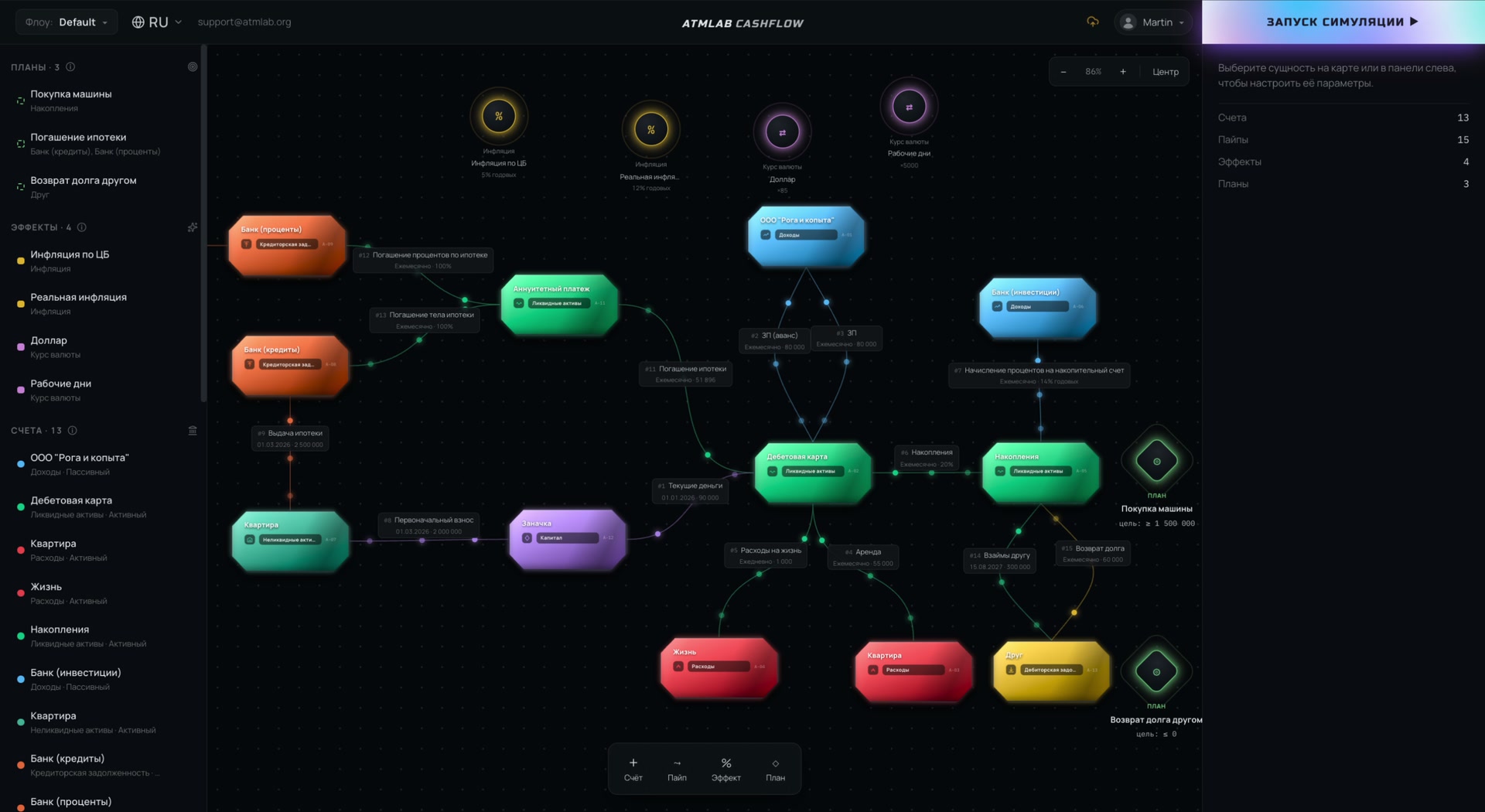
Accounts keep track of the money, pipes move it between them.
02
Look into the future
Open any date on the timeline to see the state of the accounts, the profit and the loss.
03
What if?
Change the rules that move the money and see a different version of your future.
04
Compare cashflows
Compare income, expenses, profit and loss across different ways the money could move.
Questions
What happens to your money next?
01
Will there be enough money?
Will there be enough in three months? When does the cushion run out? What happens to the balance if expenses grow or income disappears for a while? Cashflow plays the model forward and shows the moment the money stops being enough.
02
What changes after a decision?
What if you hire three more people, open another location or take a business loan? Add the change to the model and see how it affects future balances, expenses, income and debt.
03
What pays off in the long run?
Is a mortgage better than renting? What changes if you overpay the loan every six months? What comes out of a deposit with regular top-ups? Compare the scenarios and see where each one leads in a year, in five years or in twenty.
04
Where do the finances end up over time?
How much will a particular account hold in six months, a year or five years? How does the amount change once inflation or a rate is applied? How much is available at any given moment? The model answers that at whatever point in time you pick.
What it is
Cashflow turns financial questions into a model
This is not a calculator that answers one question and forgets it. You assemble a model of your own financial reality: where the money sits, how it moves, when the operations happen and what affects them. The model then plays forward, and the state of every account can be read on any date.
That is what makes a decision testable before it is made. Changed a salary, added a loan, moved a payment, planned a large purchase? You change the rule, the whole future is recalculated with it, and the two versions can be kept side by side.
Accounts describe where the money is, whom you owe and who owes you. Liquid and illiquid assets, receivables and payables, equity, income and expenses are all kept apart.
Pipes
The rules that move money
A pipe connects a source to a recipient and defines the movement. The amount can be a fixed sum, a share, an interest rate or a formula that depends on other accounts.
Schedules
When exactly the operations happen
Every pipe carries its own schedule. Payments can follow different rules, and schedules can be combined with one another or subtracted from one another. The dates are recalculated while you are still setting the model up.
Effects
How the value of money changes over time
Inflation and conversion restate amounts under the conditions you choose. You set the coefficients yourself, so this works not only for currencies but for other units of measure as well.
Plans
Where your model is supposed to get you
A plan ties a financial goal to your accounts. Set a down payment for a given date or a reserve worth several months of expenses, then check whether the current setup actually gets you there.
Flows
One separate version of your financial future
A single flow holds one complete version of the model. Build several and compare them: different decisions about a loan, about spending, about investments or about a large purchase.
The simulation
Play the model forward into the future
Cashflow does not stop at a single date. The model computes the movement of money across time, so you can open any moment and see what the accounts were doing right then.
That is how a decision gets tested before it is made. Add an operation or change a rule, run the model again, and the new future is there immediately.
Personal finance 2026 Run simulation
Income+ 420 000
Salary card182 400
Investments1 260 000
Deposit640 000
Mortgage− 2 100 000
Living costs− 74 800
Mar 2026
Analytics
What you can see once it has run
A snapshot on any date
Look at the state of your finances on any date you choose, or at the moment of one particular operation. You can see how much money and how much debt there was and what added up to that result.
The movement of money
Where the money comes from, where it goes and how the movement changes over time. Individual operations can be traced, so it is clear what shapes the future balance.
Balances and the bottom line
Balances per account, income, expenses, profit and loss, debt, equity and assets. Every figure is derived from the same assembled model.
Cash gaps
The model marks the moments when the available money is not enough for the movements you planned. The gap shows up in advance, and different ways of closing it can be tried out.
Inflation and conversion
Compare amounts as they are and after your coefficients are applied. You can see what a given sum is worth later on, or what it turns into when converted.
Comparing scenarios
Build several versions of the future and put them side by side: renting against a mortgage, a loan with overpayments against the standard schedule, or a few directions the business could take.
Who it is for
Who Cashflow is for
Cashflow suits people whose financial decisions reach beyond today.
Investor
Can model capital and returns.
Business owner
Can test how the company develops.
Anyone with a loan, a deposit or a mortgage
Can look at the consequences of a decision before making it.
It earns its keep wherever the financial picture is made of many connected events. Instead of separate calculators and spreadsheets, they go into one model and the result is visible over time.
FAQ
Frequently asked questions
Do I need to understand accounting?
No. Cashflow runs a complex calculation model inside, but what reaches the screen is plain: accounts, money, balances, income, expenses and debt. You never need the accounting vocabulary.
Can I see what happens to the money years from now?
Yes. The model plays forward and a snapshot can be taken on any date: a few months out, a year, five years or longer.
Can I compare several ways things could go?
Yes. Each version lives in its own flow. Compare renting against a mortgage, different loan terms, or a few directions for the business, and see where each one leads.
Can it account for inflation and currencies?
Yes. The model has effects for inflation and conversion. You set the coefficients, so amounts can be restated over time and brought onto whatever scale you choose.
Can it handle a deposit and interest?
Yes. Movement is described by pipes, and a pipe can carry a fixed sum, a share, an interest rate or a formula based on other accounts. Accruals and top-ups become part of the same model.
Do I have to import data from my bank?
No, and there is no bank import in Cashflow. You enter the model yourself, and the system computes the movement of money and the future state of the accounts from it.
See what happens to your money
Assemble your own financial model and test your decisions against the future it produces. Cashflow is free while the product is in beta.