Mortgage or rent: how to work out which is cheaper
The question of whether a mortgage or rent is cheaper is not really about the rate. It is about what happens to all the money around that decision over the next few years. So here is one flat, two scenarios and a full calculation of both.
What will be on your accounts in five years
Anyone who has thought about a mortgage has asked the same thing: will there be enough money, and for how long.
Will there be enough if the mortgage starts in six months? At what point does the money run out? Is it cheaper to rent or to buy a flat? If the job goes, how long can the payments carry on?
None of these is a question about a rate or the size of a monthly payment. They are questions about a state: what the accounts look like on a particular date, two years from now or five.
Mortgage or rent: why a calculator does not answer the question
A mortgage calculator answers exactly one thing: the size of the monthly payment. It knows nothing about the rent, the salary, the cost of living or the savings the down payment comes out of.
Excel knows about all of it, which is why most people end up there. And it works: lay out a schedule, write the formulas, get a number.
The trouble starts on the second scenario. Change the loan amount and you have to redo the interest, the term, the split of each payment and every balance after that date. Miss one link and the model still shows a confident number, just the wrong one.
Where exactly Excel stops coping is covered separately: forecasting cash flow in Excel.
A financial model is accounts and pipes
Only two things are needed.
Accounts are boxes that hold money: the salary card, the savings, the flat, the debt to the bank, the landlord, even the cost of living.
Pipes carry money from one account to another by a rule and a schedule: 160k on the fifth of every month, 1k every day, 2m in one go.
That is all. Two entities are enough to describe any financial model.
Underneath sits double-entry bookkeeping: money never appears from nowhere, every rouble came from somewhere and went somewhere. That is why the forecast adds up instead of drifting.
The general method is set out separately: how to build a financial model from scratch. Here it is put to work on one concrete decision.
Building the mortgage model step by step
Take a concrete case:
- Salary: 160k a month
- Living costs: 1k a day
- Rent: 50k a month
- Saved for the down payment: 2m
- Mortgage: 3m at 9%
- Monthly payment: 80k a month
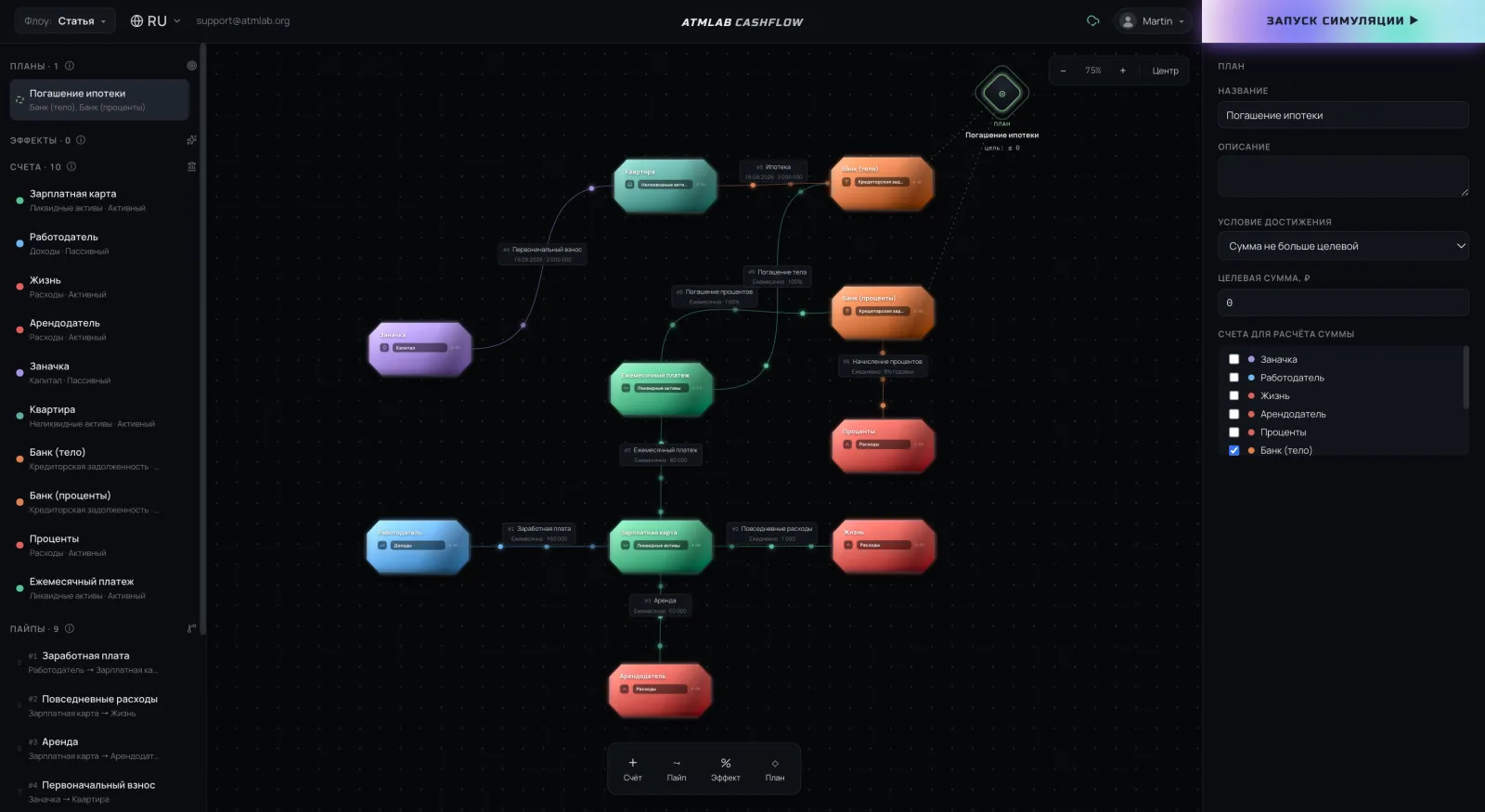
Salary. Money goes from the employer to the salary card: 160k on the fifth of every month.

Living costs. 1k a day leaves the card and goes to the living account.

Rent. 50k a month goes to the landlord.

Down payment. 2m moves in one go from the savings to the flat.

The savings account is how money that already existed before the model starts gets into it.
The mortgage itself. 3m moves from the bank to the flat. The flat is an asset, the debt to the bank is a liability, and both stay visible separately.

Interest. It accrues daily: 9% divided by 365 of the outstanding principal.

Interest lands on a separate account instead of going back onto the principal. Otherwise it would start compounding, and a mortgage does not work that way.
Repayment. 80k a month goes to a payment account. From there the interest is covered first, and whatever is left reduces the principal. The order matters.

That is the whole model: ten accounts and nine pipes.
Running the simulation
The simulation runs from the earliest operation in the model to the latest. At any point on the timeline you can see the balance of every account, the profit and loss, the cash gaps and the date a goal is reached.

In this scenario the mortgage closes on 19 June 2030, and about 550k goes to the bank in interest along the way.
The second scenario: a pricier flat and no rent
Now change the decision. Borrow a million more, take a flat that can be lived in straight away, move in and stop paying rent. The 50k that used to go to the landlord goes into early repayment instead.
Three things change in the model: the mortgage pipe carries 4m instead of 3m, the rent pipe runs only until the purchase date, and a new pipe sends 50k a month into the payment account. Setting that up takes about half a minute.
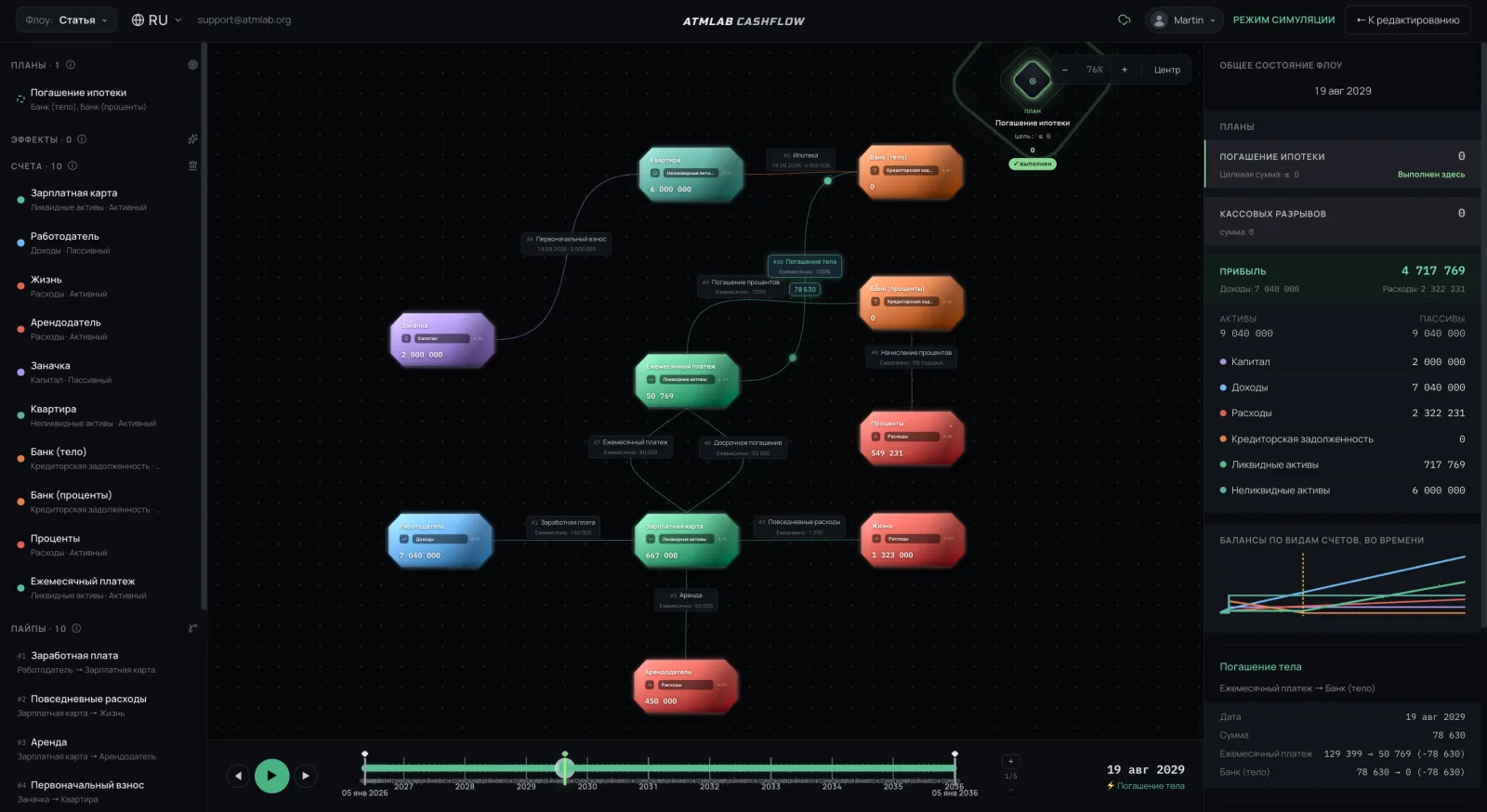
What the model shows:
- The mortgage closes on 19 August 2029 instead of 19 June 2030, ten months earlier.
- Interest paid to the bank is almost the same in both scenarios, around 550k, although a million more was borrowed.
- By the time the mortgage closes, the second scenario is a million ahead on profit.
So is a mortgage or rent cheaper
On these numbers the mortgage wins, and by a clear margin.
There are two reasons for it, and they work together.
The first: rent leaves for good, while the same 50k sent into the principal stays with you as an asset.
The second: interest is charged on the outstanding debt every day, so early repayment hits twice. It shortens the term, and it shrinks the amount the interest has time to build up on. That is why the bank received almost the same in the second scenario as in the first, although a million more was borrowed.
Change the numbers and the answer changes with them. A higher rate, a smaller down payment, losing the job in the second year: each of those rewrites the outcome. Which is exactly why a model is worth more than one figure from a calculator.
And not a single formula was needed along the way.
الأسئلة الشائعة
Is it cheaper to rent or to take a mortgage?
It depends on the rate, the down payment, the size of the rent and how long you plan to stay. In the case above the mortgage wins, because the money that would have gone to a landlord goes into the principal instead. Change the rent or the rate and the answer can flip, which is why it is worth counting your own case rather than trusting a general rule.
Does early repayment always pay off?
It shortens the term and cuts the interest, but it also takes money out of your hands. If the same money on a savings account earns more than the mortgage rate, the answer is different. Both options can be described in a model and compared side by side.
How do you see the moment the money runs out?
A cash gap is the point where an account has to pay out more than it holds. A model shows it in advance, on the date it would happen, while there is still time to change something.
How long does it take to build a model like this?
The one in this article is ten accounts and nine pipes. Describing it takes a few minutes. Changing a scenario and recalculating takes seconds, because the engine works out the sequence of operations itself.