How many years until you can quit work for good: an exact calculation
The popular FIRE formula says: multiply your annual expenses by 25, save that amount and never work again, withdrawing 4% of the capital each year. The maths is simple, but it does not answer the main question: on which exact day the goal will be reached.
Why Excel breaks on early retirement
Estimating the amount you need for financial independence is easy. If you spend about 110 thousand roubles a month, that comes to a little over 1.3 million a year. Multiply by 25 and you get the target capital: roughly 33 million roubles.
The trouble starts when you try to work out how many years it will take for that amount to be on the account. Future money keeps losing value. Your salary and the prices around you grow at different speeds, rent goes up, and the state takes 13% income tax both from your main income and from your gains on the stock market.
To find the exact date, you would have to work out every indexation and every tax for each month ahead and bring future savings back to today’s purchasing power. In Excel that means building a huge table with tangled cross-formulas. One mistake in a single cell, and the whole forecast quietly moves your retirement several years forward or back.
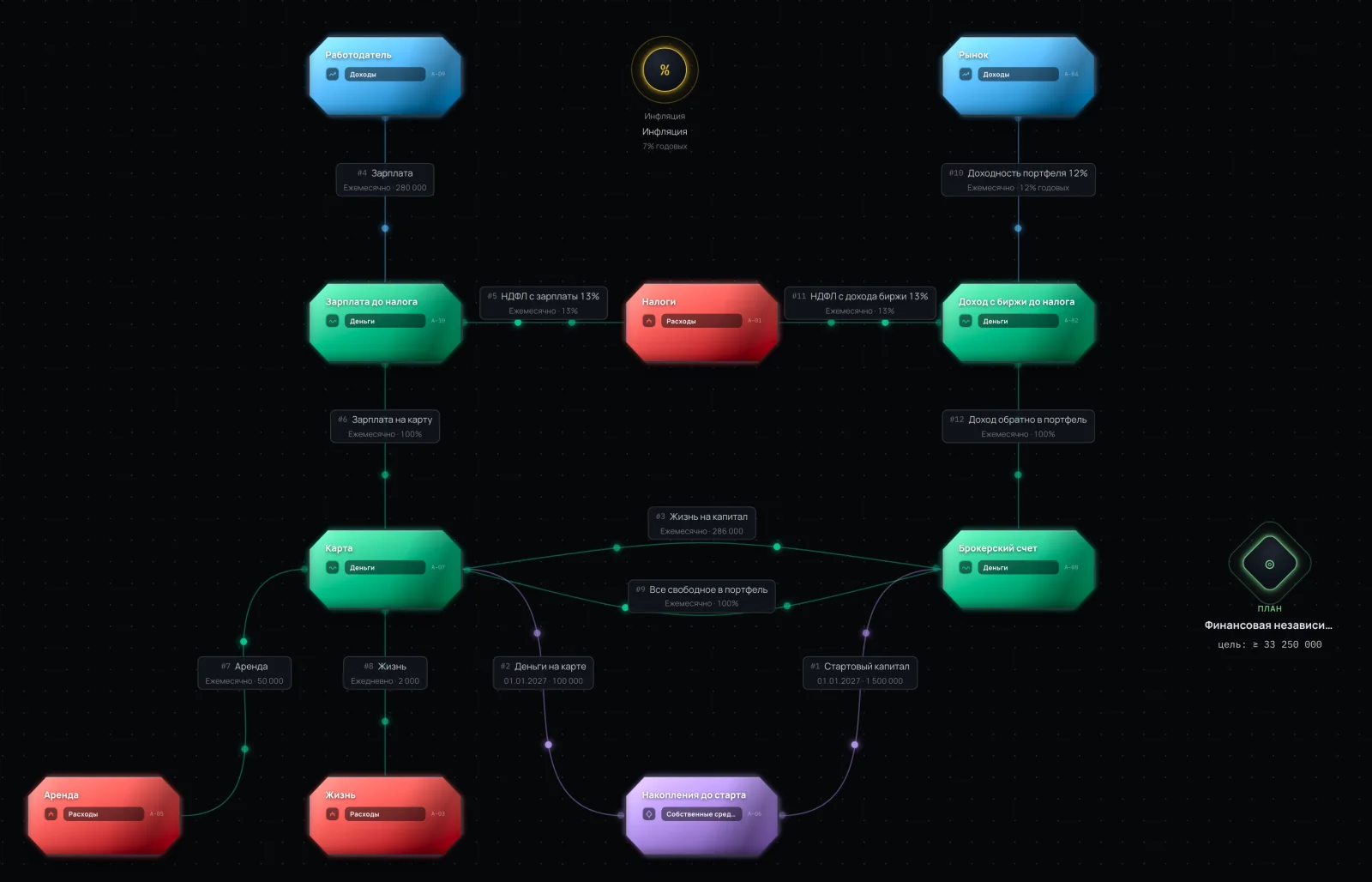
Instead of tangled spreadsheets, I built this calculation in Cashflow — a service that models how money moves over time. Money here is arranged simply. There are accounts — boxes that hold money. And there are pipes — tubes through which money flows between accounts by a schedule and a rule.
The main feature for FIRE followers: future money is automatically brought back to today’s value by the inflation rate. You simply set the goal in today’s money, and the system itself recalculates how the capital loses value, takes taxes into account and finds the exact day the goal is reached, without any formulas.
The scenario: saving all the way to the goal
For the calculation I took a basic setup for a specialist with a good income. At the start there are 1.5 million roubles on the brokerage account and 100 thousand on the everyday card. A salary arrives every month: about 245 thousand roubles after tax. Expenses are about 110 thousand a month (that covers rent and everyday spending). On the fourth of every month whatever is left is automatically invested in the market at 12% a year before tax. Inflation is set at 7% a year. I left the detailed model parameters at the end of the text.

We run the simulation, and the Cashflow engine finds the exact date. The goal will be reached on 4 December 2040 — exactly 14 years from now.
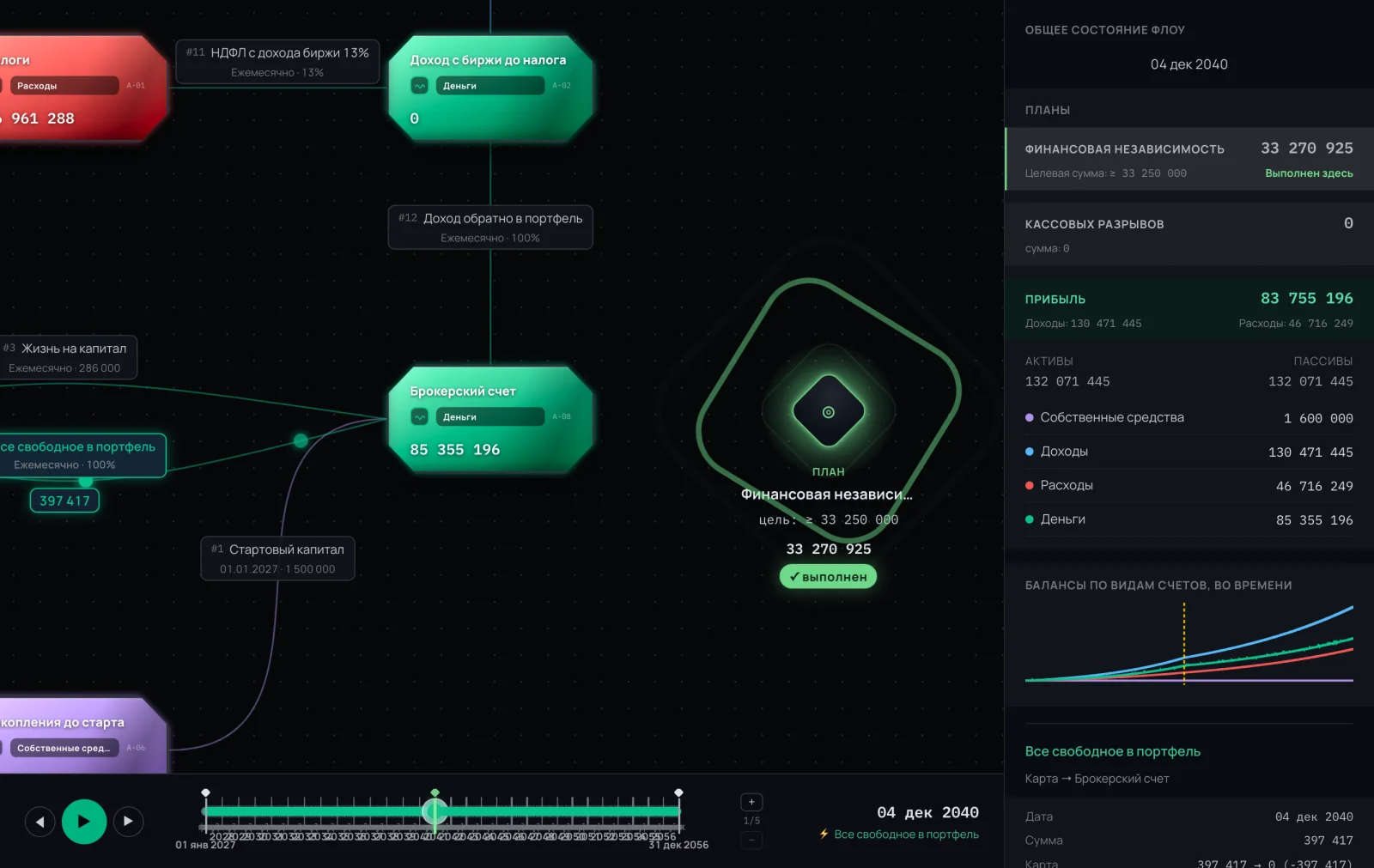
On that day the brokerage account will nominally hold about 85 million roubles. But because of inflation, their real purchasing power will be exactly our target of 33 million.
Once the goal is reached, you can calmly work until New Year and retire on 1 January 2041. By then the capital will have grown to 86 million roubles. It is interesting to see what it is made of:
- The salary brought in 40.4 million roubles.
- The starting capital was 1.6 million roubles.
- The market earned 44.1 million roubles (already after tax).
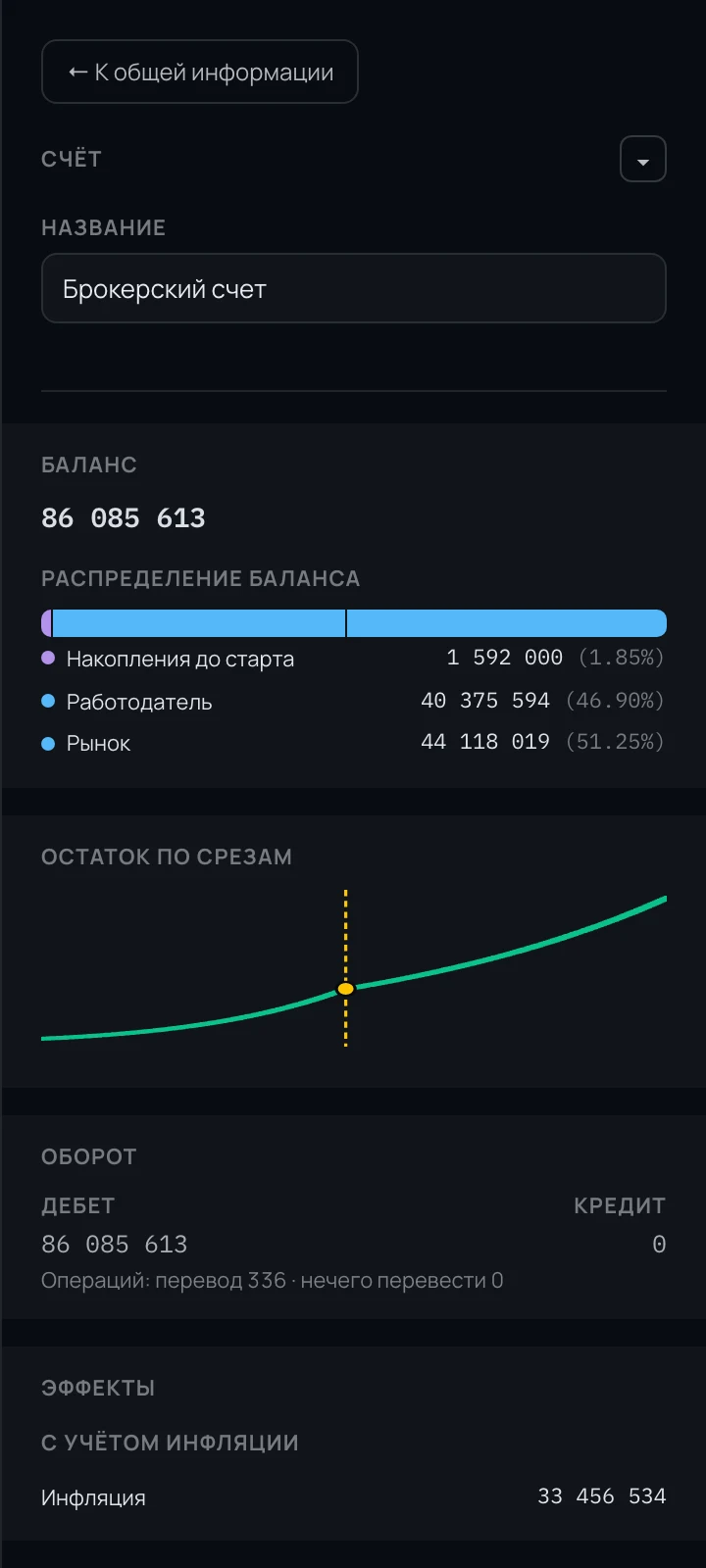
In the first years the portfolio grows mostly through personal contributions from the salary. But closer to the end the market takes over and delivers more than half of the final amount.
From 2041 we stop working, and the brokerage account starts sending 286 thousand roubles to the card every month. This is the classic 4% rule in action: the amount covers expenses that have grown with inflation and keeps being indexed by the same 7% every year.
Will the money last a lifetime
The model in the service looks exactly 30 years ahead, so the calculation ends in December 2056. That leaves 16 years of living purely on the capital.
Over all those 16 years the system did not record a single cash gap. There is enough money every month. In nominal terms the account swells to 240.7 million roubles by the end of the calculation. In today’s money, however, the capital slowly melts: over 16 years it went down from 33.4 million to 31.6 million. The savings shrink by roughly 100 thousand roubles in today’s money every year.
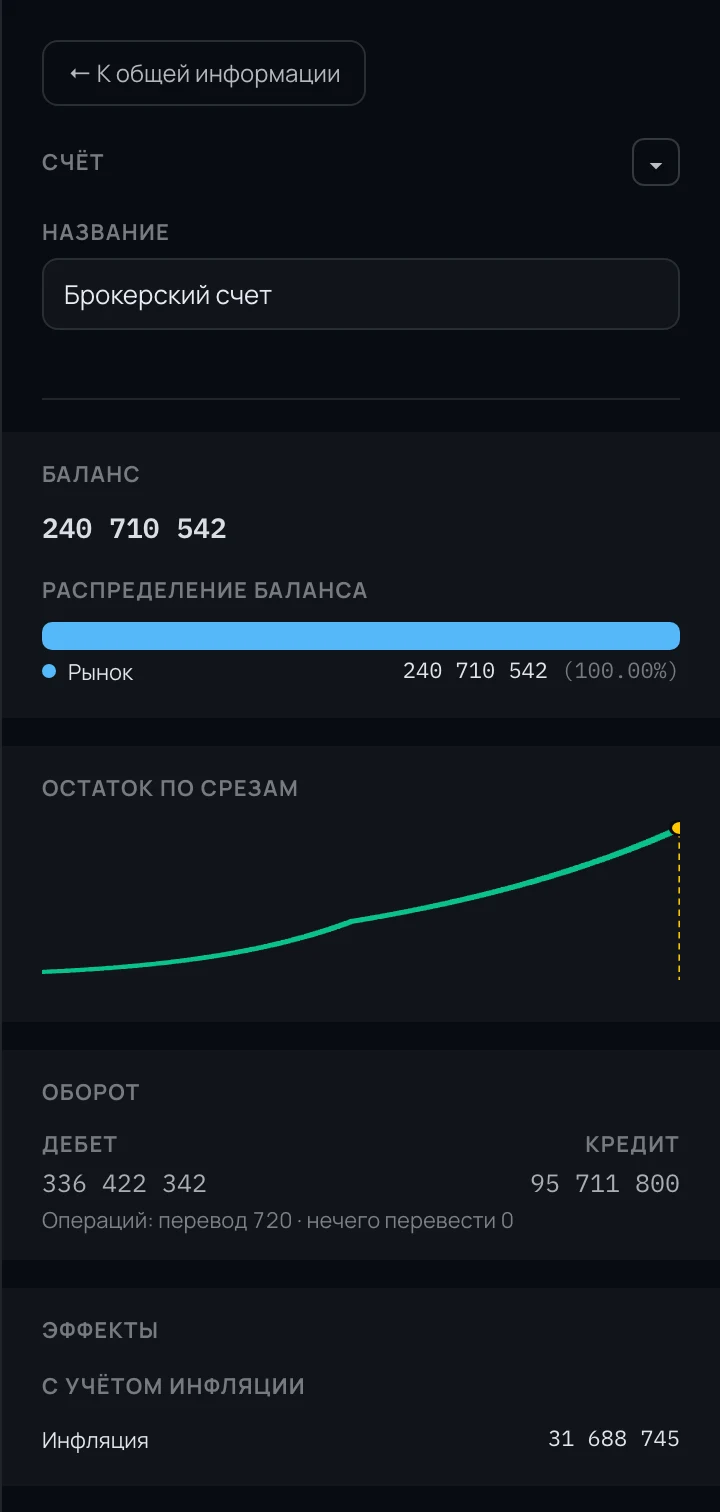
Why does this happen? The answer is the hidden loss to taxes. A 12% portfolio return turns into 10.44% after income tax. With monthly accrual, the actual annual return is about 10.9%. Subtract 7% inflation and the portfolio’s net real return is about 3.7%. And we withdraw by the 4% rule. A difference of a third of a percent looks negligible, but over a long distance it slowly starts eating into the capital itself.
At the current pace the money will still last several decades beyond the 30-year horizon. But if you want to stop the portfolio from shrinking altogether, the model needs adjusting:
- Pay less tax (use an individual investment account or the long-term holding exemption).
- Earn more during the saving phase to build a bigger starting portfolio.
- Cut retirement spending by at least 5% of the planned level.
Any of these changes can be made in the model in a couple of minutes, and you see the new result straight away. By the way, over the whole 30 years taxes took an impressive amount — about 55 million roubles, and 17 million of it went to the state before retirement. The last years before retirement turn out to be the most valuable for the portfolio: by then its own return fully outpaces any regular contributions from the salary.
What the model was made of
To keep the calculation transparent, I built a clean basic model without extra complications. Here are its exact parameters:
- Starting capital: 1.5 million roubles on the brokerage account and 100 thousand roubles on the card.
- Income: a salary of 280 thousand roubles before tax (about 245 thousand roubles after tax). The salary grows by 8% a year.
- Taxes: 13% income tax. The flows are set up realistically: money first arrives on a transit account, 13% is automatically sent from there to taxes, and the rest goes to the everyday card. The tax grows along with income.
- Expenses: rent of 50 thousand roubles a month, everyday spending of 2 thousand roubles a day (about 60 thousand roubles a month). In total, about 110 thousand roubles of starting expenses. Spending grows by 7% a year.
- Investments: on the 4th of every month all spare money on the card is moved to the brokerage account.
- Return: 12% a year before tax, with interest accrued once a month. A 13% tax is also withheld from investment income, and the net remainder goes back into the portfolio.
- Inflation: 7% a year.
What the calculation still lacks
We built a simple, clear model to test whether the FIRE maths itself holds up. Real life has many more conditions, and they need to be taken into account too:
- Market volatility. Our model assumes a steady 12% a year. The real stock market behaves chaotically: there are crises and long downturns. If you catch a major market drop in the first years after retirement, it hits the longevity of the capital very hard.
- Different asset types. In real life nobody keeps all their savings on a single brokerage account. Shares, bonds and bank deposits come with different interest rates and their own tax rules.
- Unexpected risks. The current figures include no costs for serious medical care, a major renovation or replacing broken appliances. These threats need to be built into the model as regular reserve funds or spread over the whole period.
- Progressive tax. We applied the minimum income tax rate of 13%, although once income grows past certain limits, the state’s rate goes up.
- State pension. It can slightly ease the load on the capital in older age, but we did not include it in the model.
There is no need to work all these details out on paper. Cashflow lets you adapt the model flexibly to real life: you can give every deposit its own account with its own rate, turn risks into a yearly expense pipe, and simulate a market drop as a one-off withdrawal in any year you choose.
In the next article we will make the financial model more complex, add real taxes, several investment instruments and stock market crises, and put together the most honest early retirement scenario.
Work out your own retirement date
Instead of trying on other people’s financial scenarios, build your own model. Plug in your income, your real expenses and your savings. The service will roll your money forward in time and find the exact date when you can quit work for good: ATMLAB Cashflow.
常见问题
What is the 4% rule and where do the 25 years of expenses come from?
They are two sides of one financial formula that became the basis of the FIRE movement. The rule came from the Trinity study, in which economists examined how portfolios held up on the American stock and bond market. It turned out that if you withdraw 4% of the accumulated capital in the first year of retirement and then take the same amount every year adjusted for inflation, the portfolio is guaranteed to last at least 30 years. Mathematically, 25 years of expenses and a 4% withdrawal are the same ratio, since one divided by 0.04 gives exactly 25.
Why does the capital gradually melt if we withdraw exactly 4%?
The classic 4% rule assumes that the net real return of your portfolio (the nominal rate minus inflation and taxes) will be no lower than the 4% you take out to live on. In our calculation, a nominal 12% a year turns into a net 10.9% a year after paying 13% income tax every month. Subtract 7% inflation, and the real return of the portfolio is about 3.7%. Since we spend 4%, a small gap of 0.3% appears, and over decades it slowly shrinks the capital itself.
How do you take inflation into account properly when planning FIRE?
The main mistake in manual calculations is trying to guess the nominal price of things 10–15 years ahead and fit the size of the capital to it. Future money is worth less than today’s. Cashflow solves this systematically: you set the expected inflation rate in percent, and the service automatically brings any future balance on the timeline back to today’s purchasing power. Your financial goal is set in fixed money of today, and the simulation engine itself recalculates every income indexation and finds the date the goal is really reached.
Can a FIRE model be calculated reliably in plain Excel?
Working out a final static amount in Excel takes a couple of seconds, but building an accurate dynamic model of money moving over 20–30 years ahead in spreadsheets is extremely hard. You would have to create a giant matrix where every month has formulas for salary indexation, rising prices, compound interest on the portfolio balance and monthly tax withholding. Any change in conditions, for example a temporary job change or new large expenses, would mean rewriting the logic of hundreds of cells, where a critical mistake is easy to miss.
What if the calculation shows retirement too late?
A financial model is valuable because it shows clearly which levers affect the result most. If the date the plan is reached does not suit you, there is no reason to give up. In the same model you can test the three main decisions one by one: legally reduce the tax burden on investments (switch to an individual investment account), raise your income during the saving phase by growing in your profession, or plan a slightly more modest level of spending in retirement. Changing any parameter immediately recalculates the model and shows the new date.